
Originally published on skepticalartist.com on 25 June 2013, where it found a wide audience; restored here from the Internet Archive.
Everybody sees the world around them in different ways and although this is usually down to interpretation, some people can physically see more of the world around them. It’s claimed that Monet was one of them.
Monet and Ultraviolet vision
I’ve often heard that Monet had Ultraviolet vision and examples of how widespread this is thought can be found in this article in the Science section of the Guardian and in this article in the Daily Mail. It’s stated as fact all over the web but I’m still skeptical. It’s very easy to read something that’s repeated often and believe it especially when there are examples like the one above. Recently I’ve been taking more of a critical approach. Where do these claims come from and is there evidence to back them up ? There are many specialists who are pretty easy to locate by doing a few Google searches. Have they been consulted or quoted by the authors of these pieces ?
In this article I’m going to be doing some research on whether this is possible and whether this is probable. I’m entering this investigation with an open mind, a background in Art History and an interest in the facts.
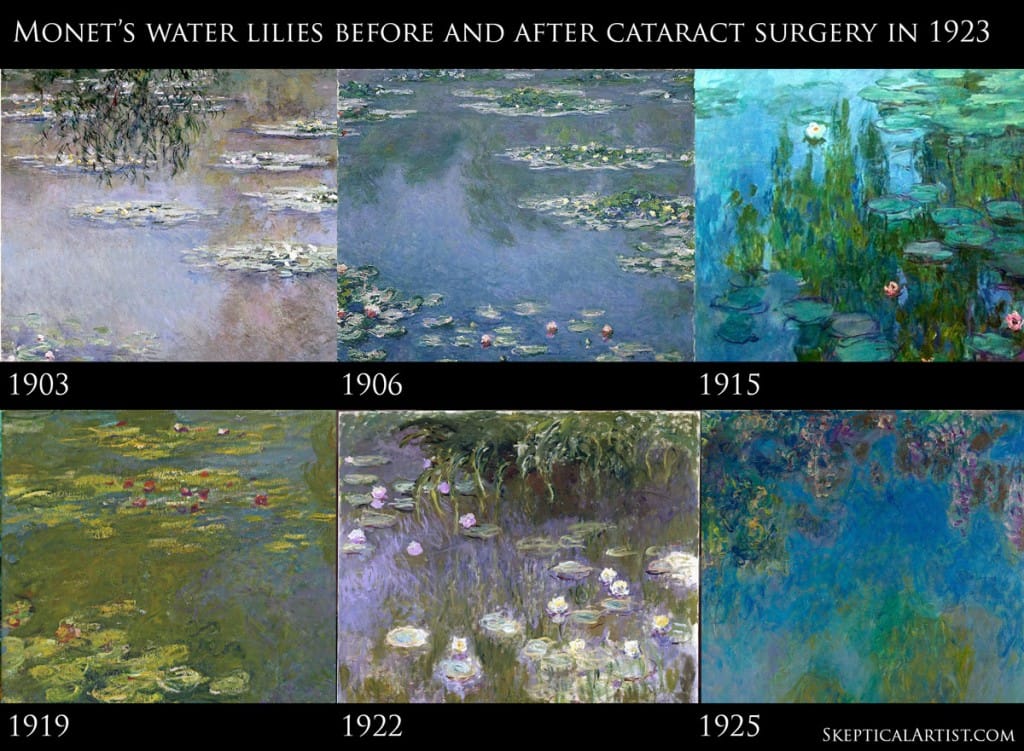
I created a composite below of some of Monet’s paintings of Water lilies. This doesn’t have the same dramatic impact as the image at the top of this article as it doesn’t indicate any great change. He only lived for 3 years after his cataract operation and there are relatively few paintings that can be attributed to that period. It also appears that he was using a fairly blue palette before his operation. It is possible that he went back and corrected his paintings at a later date.
Background
From early on in his career Monet rejected traditional methods of painting and didn’t want to paint what he knew was there but what he actually saw. In Paris at the Charles Gleyre academy he’d been taught to paint the sea as blue and the bark of a tree as brown but as he advised another painter:
When you go out to paint, try to forget what objects you have before you — a tree, a house, a field. . . . Merely think, here is a little square of blue, here an oblong of pink, here a streak of yellow, and paint it just as it looks to you, the exact color and shape.
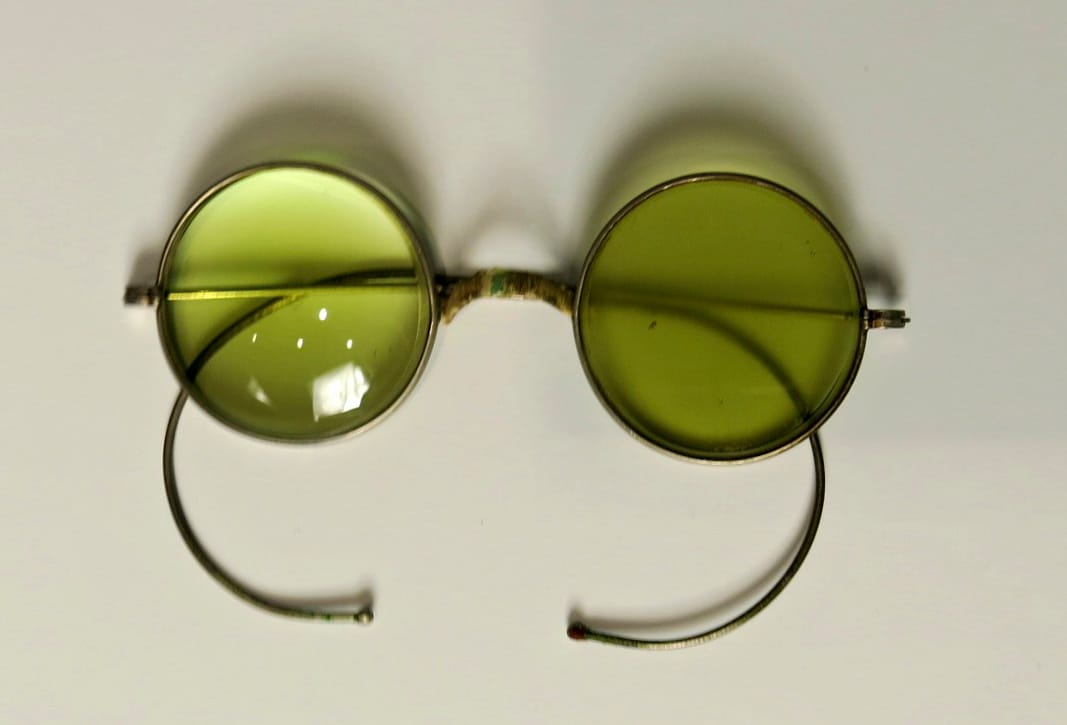
He wanted to create an impression of a scene at a particular time and capture what it was like at that particular moment. From 1900 onwards Monet had problems with his vision and complained to his friends that everything he saw was a fog. Although cataract operations had been performed for thousands of years they were still a risky business at the time. He agreed to surgery to totally remove the lense in his left eye in 1923 at the age of 82 and the operation was a success. There were no replacement implant lenses at the time and he had to wear thick glasses but his vision was transformed.
However, the operation had an unexpected side effect; as mentioned before it’s claimed that he began seeing the world with UV vision. His palette which before the operation had been red, brown and earthy took on a more bluish hue.
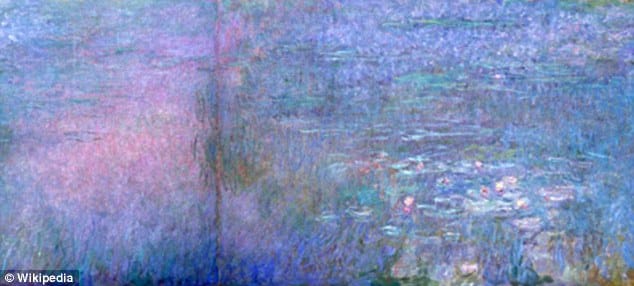
There are plenty of myths about artists so how do we know that this is true ? People often claim that Monet’s blurred style was a result of cataracts in an aging artist but this appears to be false in that he painted in this style from a young age.
What kind of light can we usually see ?
This diagram pretty clearly shows how how small the spectrum of light as part of the spectrum of electromagnetic radiation really is. The typical human eye will not respond to light below 390nm. The rod and cone cells in our retina have the potential to detect light down to 290nm, but our lenses block out everything below about 390nm.
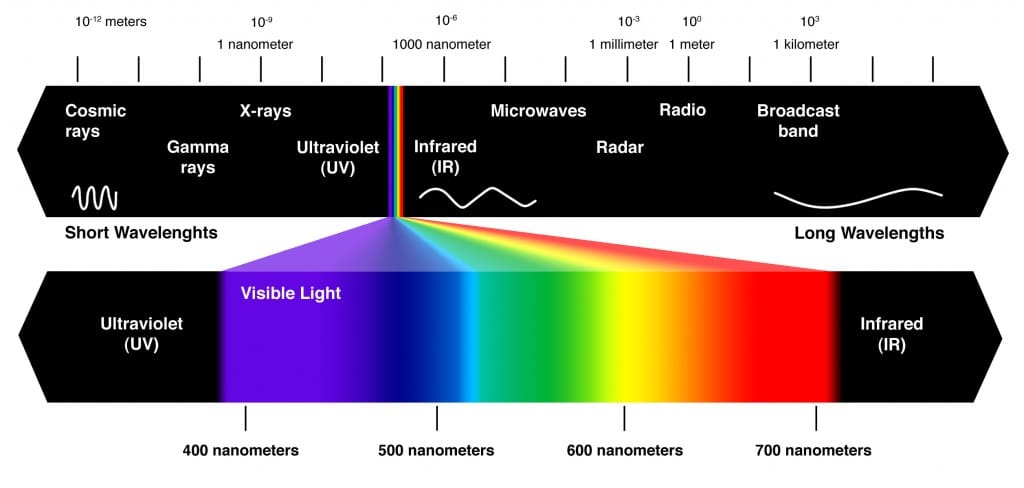
From what I’ve read it’s possible that if you remove or replace the lense of your eye then these rays are no longer blocked and if an individual’s retina is sensitive to ultraviolet rays then they will be able to see Ultraviolet rays.
Does anyone in the 21st century have Ultra Violet vision ?
A retired Air Force Officer and Engineer called Alek Komarnitsky underwent cataract surgery in 2011. This is a pretty common operation which according to wikipedia is performed on over 2 and a half million people a year in the United States.
After undergoing this operation he appears to have become more sensitive to the low end of the visible light spectrum. On his website he puts across a very convincing case that he has Ultraviolet vision. By testing with a Monochromator at Hewlett-Packard, Komar was able to see purples at around 350nm and tiny bits of brightness down to 340nm.
The team at The Skeptics Guide to the Universe also seem convinced and if you listen in about 17 minutes into podcast 413 from June 15th 2013 they also mention Monet and his UV vision.
Not entirely relevant but just as exciting are experiments currently being performed to create retinal implants that could be used to cure some kinds of blindness. These implants would enable users to see a full spectrum of light rays that are not ordinarily visible.
Ultraviolet Photography
Digital cameras are generally manufactured with a filter over the sensor that stops them from recording Ultraviolet and Infra Red Light. It is however possible to have this filter removed so that you have a “Full Spectrum Camera”. By then using different filters on the front of your lense you can make sure that your camera only takes photographs which record a certain spectrum.
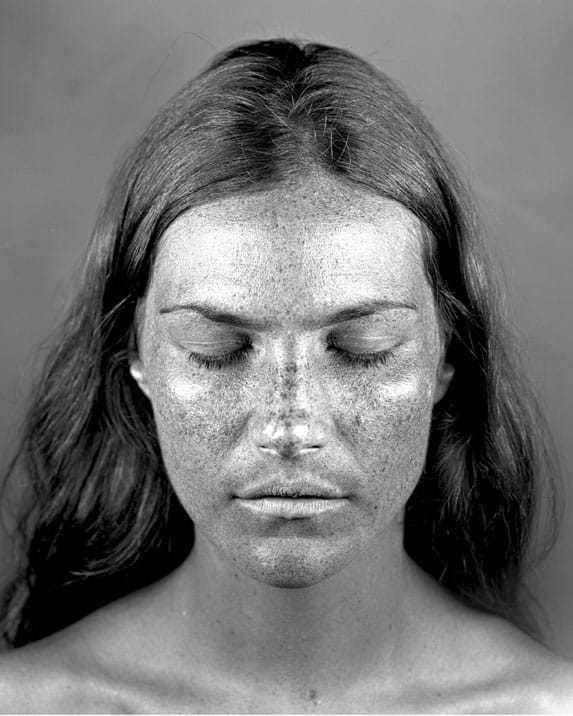
Many portraits taken using only UV light between the wavelengths of 335 and 365 nanometers to create images with a similar stunning effect.
Animals with ultraviolet vision
Although people can only see certain wavelengths many animals can see a broader spectrum. Insects including bees can see Ultraviolet and this can help them navigate and find flowers. There are also certain Butterflies where both genders look exactly the same to us but to each other (or someone who can see UV) the males have bright patterns which may help them to attract mates.
Conclusion
Did Monet have Ultraviolet Supervision ? It’s certainly possible but I’m still not convinced. I hadn’t realised how much information there was on the subject but come back soon as I will continue to look into this.
Please leave a comment if you have any more information or think I’m wrong. I’d love to hear from you.
Further Reading
- http://www.extremetech.com/computing/118557-the-eyes-have-it-seeing-ultraviolet-exploring-color
- http://www.komar.org/faq/colorado-cataract-surgery-crystalens/ultra-violet-color-glow/
- http://www.naturfotograf.com/UV_IR_rev01UV.html#top_page
- http://singularityhub.com/2010/11/09/retina-implant-restores-vision-lets-cyborgs-see-ir-light/
- http://ask.slashdot.org/story/11/10/02/1937232/ask-slashdot-how-to-exploit-post-cataract-ultraviolet-vision
- http://answers.yahoo.com/question/index?qid=20111126225836AAfGYmn
- http://www.dpreview.com/forums/thread/3069650
- http://www.dailymail.co.uk/sciencetech/article-2080438/Why-DID-scorpions-evolve-glow-UV-light-The.html
- http://www.lakeshorevision.com/cataracts-lasik-ilasik-blade-free-lasik-restor-len-implants-toric-implants-contact-lenses/premium-lens-implants-no-stich-cataract-surgery-multi-focal-lenses-toric-lenses/monet-and-cataracts-by-dr-martha-jay-milwaukee-area-ophthalmologist
- http://en.wikipedia.org/wiki/Color_vision